How Nutritional Deficiencies Block Recovery in Chronic Diseases
The Missing Link Between Treatment and True Healing
Many people with chronic diseases ask the same question:
“I am taking treatment, my reports are monitored—then why am I not recovering?”
In clinical reality, the answer is often not the disease itself.
It is a nutritional deficiency at the cellular level.
Chronic diseases do not persist only because of pathology.
They persist because the body lacks the biological resources required to heal.
This article explains how nutritional deficiencies silently block recovery—and why correcting them is essential for Natural Immunotherapy and long-term healing.
A Hard Truth About Chronic Disease Recovery
Modern treatment focuses on:
- controlling symptoms
- suppressing inflammation
- managing disease markers
But healing requires something else entirely:
Cells must repair.
Immune systems must regulate.
Inflammation must resolve.
None of this can happen without vitamins, minerals, and micronutrients.
What Nutritional Deficiency Really Means (And Why It’s Missed)
Nutritional deficiency today is rarely about starvation.
It is cellular malnutrition, caused by:
- poor nutrient absorption
- chronic inflammation
- digestive weakness
- liver overload
- long-term stress
- repeated illness
Many patients:
- eat regularly
- Take medicines correctly
- follow treatment plans
Yet their cells remain biologically undernourished.
Blood tests often fail to reveal this fully, because:
- serum levels ≠ cellular availability
- deficiency exists at the functional level
This hidden deficiency is one of the biggest reasons recovery stalls.
Why Chronic Diseases Demand More Nutrition, Not Less
Chronic disease places the body in a constant repair state.
This dramatically increases the need for:
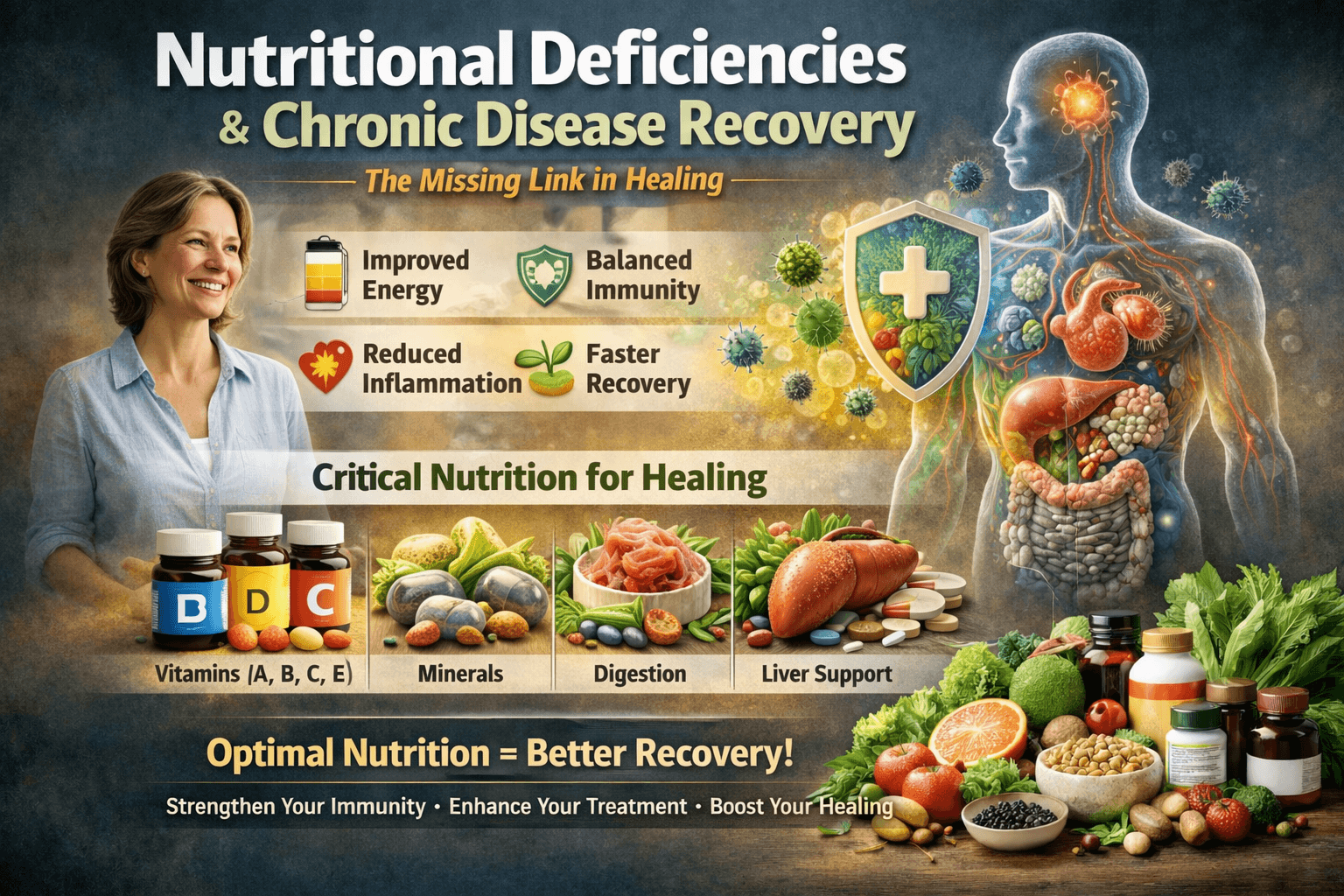
- vitamins (A, B-complex, C, D, E, K)
- minerals (magnesium, zinc, iron, selenium, copper)
- cofactors for enzymes and detox pathways
If these nutrients are missing:
- immune cells malfunction
- Inflammation never resolves
- tissue repair remains incomplete
- fatigue and weakness persist
Treatment may control the disease, but recovery cannot be complete.
How Nutritional Deficiencies Block Immune Recovery
The immune system is the executor of healing.
But immune cells require nutrients to:
- recognize abnormal cells
- communicate accurately
- regulate inflammation
- complete repair cycles
When nutrients are deficient:
- immunity becomes confused
- Inflammation stays chronic
- healing signals fail
- Immune exhaustion develops
This is why many chronic disease patients experience:
- repeated relapses
- slow progress
- frequent infections
- unstable improvement
Without nutrition, immunity cannot heal; it can only react.
The Digestive Trap: Why Eating Well Is Not Enough
One of the biggest misconceptions is:
“I eat healthy, so I cannot be deficient.”
In chronic disease, digestion is often impaired.
Poor digestion leads to:
- incomplete nutrient breakdown
- poor absorption
- toxin formation
- gut-immune imbalance
Even the best diet becomes ineffective if:
- Stomach acid is low
- Enzymes are weak
- Gut lining is inflamed
- Liver metabolism is overloaded
This is why nutritional deficiency persists despite good food habits.
Liver Overload: The Silent Nutrient Blocker
The liver plays a critical role in:
- nutrient activation
- detoxification
- protein metabolism
- immune tolerance
When the liver is overburdened:
- nutrients are not converted into usable forms
- toxins recirculate
- inflammation persists
- Immune signaling gets distorted
Many chronic disease patients show:
- normal intake
- poor utilization
This creates a false sense of “adequate nutrition” while cells remain starved.
Key Nutritional Deficiencies That Block Recovery
Vitamin B-Complex Deficiency
Leads to:
- fatigue
- weak immunity
- nerve dysfunction
- poor blood production
Without B-vitamins, cellular energy collapses.
Vitamin D Deficiency
Leads to:
- immune imbalance
- chronic inflammation
- poor recovery
- autoimmune tendencies
Vitamin D is essential for immune regulation, not stimulation.
Magnesium Deficiency
Leads to:
- metabolic instability
- muscle weakness
- inflammation
- poor stress tolerance
Magnesium depletion is extremely common in chronic illness.
Zinc Deficiency
Leads to:
- poor immune communication
- delayed healing
- infection vulnerability
Zinc deficiency causes immune confusion, not just weakness.
Iron, Copper & Selenium Imbalance
Leads to:
- poor oxygen delivery
- immune enzyme failure
- oxidative damage
Both deficiency and excess can block recovery—balance is critical.
Why Medicines Alone Cannot Fix Nutritional Deficiency
Medicines can:
- block disease pathways
- suppress symptoms
- manage markers
They cannot:
- Rebuild immune intelligence
- restore enzyme activity
- correct cellular deficiencies
- complete tissue repair
Without nutrition:
- Medicine keeps disease under control
- But the body never regains strength
This is why many patients feel:
“I’m surviving—but not recovering.”
Nutrition Is Not an Add-On. It Is the Foundation.
In Natural Immunotherapy, nutrition is not supportive—it is central.
Correcting nutritional deficiencies:
- restores immune regulation
- reduces inflammation naturally
- improves treatment tolerance
- accelerates recovery
- prevents relapse
This is why nutrition-driven recovery works where symptom-focused care stalls.
Supplements as Precision Nutrition Tools
Food alone is often insufficient in chronic disease due to:
- poor absorption
- higher demand
- depleted reserves
That is where clinically designed supplements play a role.
At Dantura Botanics, supplements are formulated to:
- correct real deficiencies
- support immune biology
- improve nutrient bioavailability
- work safely over the long term
They are not shortcuts—they are nutritional bridges.
Why Correcting Deficiencies Unlocks Recovery
Clinically, when deficiencies are corrected, patients often notice:
- energy returning
- better appetite and digestion
- fewer flare-ups
- improved immunity
- steadier progress
- reduced dependency
These are signs of immune restoration, not a placebo.
A Reality Patients Must Understand
If cells are deficient, recovery is impossible.
If immunity is weak, healing cannot be sustained.
Chronic disease does not heal because the body is broken.
It fails to heal because the body is under-nourished.
Correct nutrition restores the conditions needed for healing to happen naturally.
Final Takeaway
Nutritional deficiencies are not minor gaps.
They are major biological roadblocks in chronic disease recovery.
Natural Immunotherapy works because it:
- identifies these deficiencies
- corrects them at the cellular level
- restores immune intelligence
- allows healing to complete
That is why nutrition-based recovery is not optional. It is essential medicine.